 Skip to content



Newly launched: ITIL (Version 5)
ITIL (Version 5) launches today February 12th 2026, representing the newest version of the world’s leading IT Service Management framework. This launch is timed to support organisations navigating unprecedented digital transformation. ITIL (Version 5) moves beyond traditional Service Management paradigms while firmly retaining the foundational cornerstones of effective Service Management.
Key innovations in the new ITIL
The new ITIL has been specifically engineered to thrive in today’s fast-changing, AI-driven environment. It offers practical, role-relevant guidance designed to help professionals and organisations consistently deliver measurable value.
ITIL (Version 5) is characterised by:
- Modern, integrated and comprehensive design: ITIL (Version 5) helps teams collaborate more effectively, align priorities and create value consistently.
- AI-native and practical by design: ITIL (Version 5) provides clear, practical guidance for adapting ways of working, making informed decisions and responding to change as technology, business needs and customer expectations evolve.
- End-to-end lifecycle for digital products and services: ITIL (Version 5) helps teams design, deliver and improve digital products and services with greater visibility, stronger collaboration and a clearer understanding of how different stakeholders experience value.
Breaking silos with integrated lifecycles
ITIL (Version 5) tackles one of the biggest challenges organisations face today: disconnected product and service teams. Traditionally, developing a digital product and managing it as a live service were treated as separate, linear activities—often causing delays, miscommunication, and inefficiencies. The new ITIL 5 breaks down these silos with a fully integrated, end-to-end lifecycle, spanning discovery, design, building, testing, transition, operation, delivery, and support.
The result? Faster value delivery, fewer errors, and smoother collaboration across teams. By sharing responsibility for outcomes, organisations can respond more effectively to change, align technology with business priorities, and ensure that every release, deployment, and improvement delivers measurable value.
In short, ITIL (Version 5) does not just update processes—it reshapes how digital products and services are created, managed, and improved in today’s fast-moving, AI-driven world.
Why the new ITIL
When the environment changes the framework needs to adapt accordingly, in order to remain relevant. The main reasons why there is a new ITIL in 2026 are:
- A new digital landscape
- Digital first business models
- The AI revolution
- Greater adaptability
- Stronger interconnection and value focus
- A simpler, clearer qualification scheme
ITIL (Version 5) Official Qualification Scheme
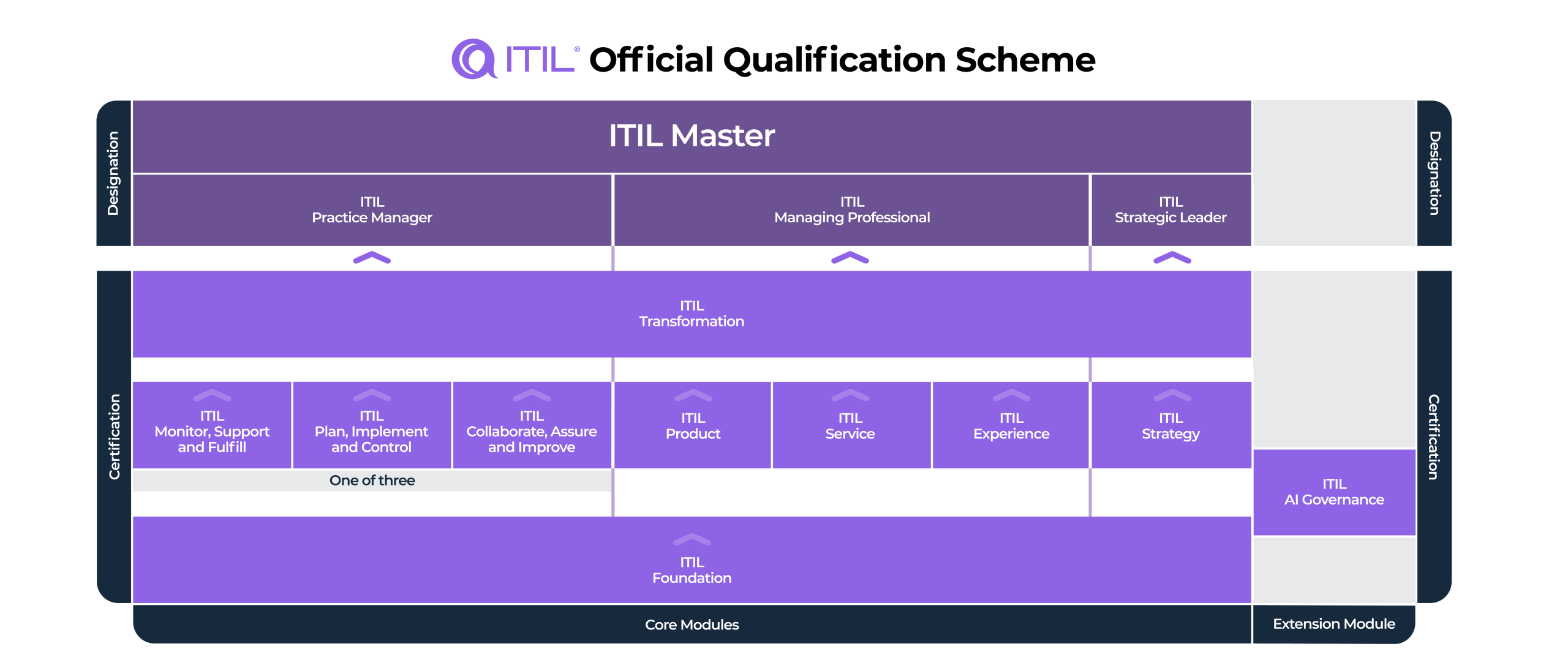
In ITIL (Version 5) the qualification scheme begins with the ITIL Foundation and continues with eight upper-level modules and one extension module.
The ITIL (Version 5) qualification scheme diagram below provides a visual overview of how the certifications and designations fit together and how candidates can progress through the framework.
If you already hold an ITIL 4 Foundation certification—or any ITIL 4 certificate—you do not need to retake Foundation to progress to ITIL (Version 5) upper-level modules. ITIL (Version 5) builds on ITIL 4, and your existing qualifications are fully recognized as prerequisites.
For a quick update on the key changes at Foundation level, you can take the one-day ITIL (Version 5) Foundation Bridge course, which includes a short exam and awards the ITIL (Version 5) Foundation certificate.
From there, you can continue your ITIL journey by selecting the upper-level modules that best align with your role and career goals, leveraging your ITIL 4 experience to connect established best practices with the latest guidance on digital product and service management.